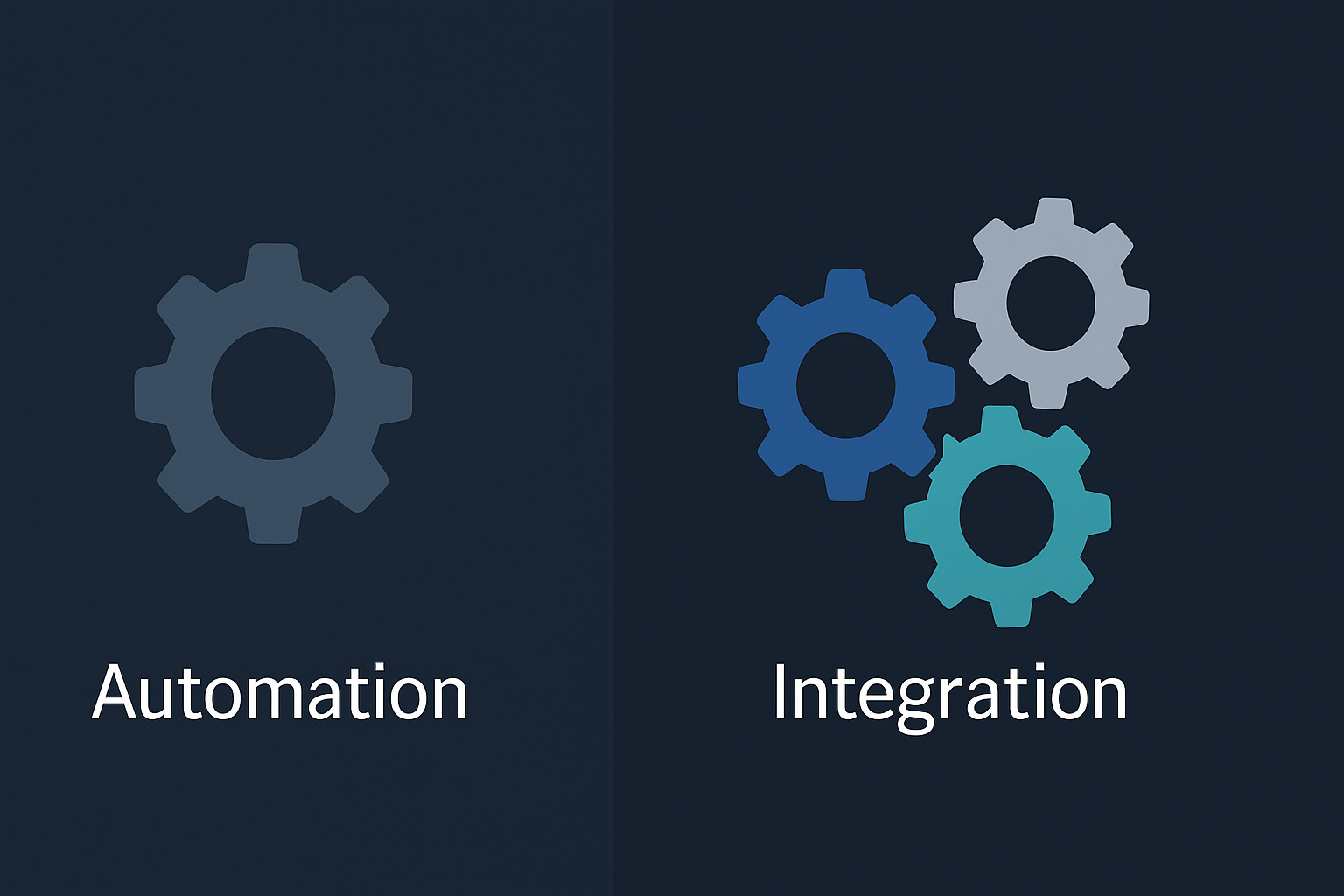
In the world of business software, “automation” and “integration” are two terms that are often used interchangeably. While they are related, they are not the same thing. Understanding the difference is the first step to building a truly efficient business.
Many business owners invest in tools to automate specific tasks, only to find they’ve created isolated islands of efficiency. Their email marketing system doesn’t talk to their CRM, and their CRM doesn’t talk to their invoicing software. The result? They end up doing manual data entry to bridge the gaps, defeating the very purpose of the software.
Let’s clear up the confusion.
What is Automation?
Think of automation as a set of pre-programmed instructions for a single tool. It’s about making a specific, repetitive task happen without manual effort.
- A Simple Analogy: Automation is like setting a coffee maker to brew at 7 AM. You set the rule once, and the machine performs the task automatically every morning.
- A Business Example: Setting up a rule in your email marketing platform to automatically send a “Welcome” email to anyone who signs up for your newsletter. The task (sending the email) is automated.
Automation is powerful for handling individual tasks. It saves time and ensures consistency.
What is Integration?
Think of integration as building bridges between your different tools. It’s about making your separate software systems communicate and share data with each other.
- A Simple Analogy: Integration is like connecting your smart alarm clock to your coffee maker. When your alarm goes off, it sends a signal that tells the coffee maker to start brewing. The two separate devices are now working together as a single, smarter system.
- A Business Example: Integrating your website’s contact form with your CRM. When a lead submits the form, the integration automatically creates a new contact in your CRM, eliminating the need for manual data entry.
Integration is what creates a cohesive, intelligent system out of your individual tools.
Why You Absolutely Need Both
The real magic happens when you combine automation and integration. This is where you move from simply saving time on one task to streamlining your entire business process.
Let’s look at a complete example of a new lead:
- Without Both: A lead fills out your website form. You manually copy their info into your CRM. Then, you manually send them a follow-up email. You’ve missed the opportunity for immediate engagement.
- With Automation Only: A lead fills out your form. Your email platform automatically sends them a welcome email. That’s good, but their information still isn’t in your CRM, so your sales team has no idea the lead exists.
- With Automation AND Integration:
- A lead fills out your form.
- The integration instantly sends their data to your CRM, creating a new contact.
- This new contact in the CRM triggers an automation that sends a personalized welcome email, notifies your sales team, and adds the lead to a long-term nurture sequence.
In this final scenario, the entire process is seamless. The lead gets an immediate response, your sales team is instantly notified, and no manual work is required. This is the foundation of a scalable business.
The Bottom Line
- Automation makes your tools do the work.
- Integration makes your tools work together.
By focusing on both, you can transform your collection of individual software subscriptions into a powerful, intelligent engine that saves you time, improves your customer experience, and drives real business growth.
Ready to build the bridges between your systems? Schedule a free discovery call to discuss your specific integration challenges.